
Siegfried an der Deutschen Oper Berlin
Siegfried, Richard Wagner
Deutsche Oper Berlin
23.05.2026
Stefan Herheim darf sich glücklich schätzen, seit der Premiere einen
so motivierten Siegfried-Darsteller wie Clay Hilley auf der Bühne zu
haben. Dank ihm, seiner fesselnden Präsenz und überbordender
Stimmkraft wird es an diesem Abend keine Sekunde langweilig. Vor
allem das Zusammenspiel mit Ya-Chung Huang als Mime lässt einen
im ersten Aufzug direkt vergessen, wie inhaltlich dünn sich die
Inszenierung durchzumogeln versucht. Die meiste Zeit verbringen die
Akteure auf oder vor dem Souffleurkasten, weil nach der Walküre nun
noch viel mehr Koffer ringsherum gestapelt sind. Später müssen sich
Sänger und Statisten einen Weg über die Kofferberge bahnen, eine
heikle Angelegenheit. Ebenfalls heikel sind mehrere Aktionen mit
großen weißen Tüchern. Die jeweils Portalfüllenden Laken werden
hoch-, runter- und seitlich weggezogen, was ein beeindruckender
Effekt sein könnte. Jedoch geht buchstäblich jeder einzelne Vorgang
schief. Ein halbes Tuch streift das Orchester, Clay Hilley wird
ausgerechnet bei „So schneidet Siegfrieds Schwert“ verdeckt,
Statisten werden davon fast umgestoßen, am Ende bleibt ein Tuch an
Koffern hängen, sodass Hilley es lösen muss, damit Bühnentechniker
es eifrig wegziehen können. Das alles wirkt nicht nur sehr bemüht und
technisch nicht durchdacht, sondern lenkt in der Fehleranfälligkeit
auch vom Geschehen ab. Dabei gibt es durchaus spannende Einfälle
im Bühnenbild. Die hohen Koffertürme werden zu Blasebälgen, der
Konzertflügel erweist sich als Mulitfunktionsinstrument und die
gesamte Bühne verwandelt sich äußerst eindrucksvoll in den
Riesenwurm Fafner (mit knorriger Bassgewalt: Tobias Kehrer).
Nur wenige inhaltliche Ansätze sind überzeugend. So setzt Siegfried
direkt am Anfang sehr deutlich
„Furcht“ mit sexuellem Verlangen gleich. Auch die Idee, den
Waldvogel mit einem Knabensopran zu besetzen (Cornelius Park mit
silbrigem Klang und guter Höhe) und somit dem Waisen Siegfried
einen kurzen Moment mit seinen Eltern zu schenken, ist rührend.
Der tote Fafner, der mehrmals wieder zum Leben erwacht, sich
verwirrt umschaut und dann wieder stirbt, die korpulierende Menge
am Ende und die überlangen Umbaupausen (bei angegeben 45
Minuten rund eine halbe Stunde länger) nehmen dem Abend einiges
an Spannung.
Ebenso spannungslos das Dirigat von Sir Donald Runnicles. Wie
immer gelingt ihm der Beginn plastisch und mystisch, aber spätestens
ab dem „zullenden Kind“ fühlt man sich in einem durchgehenden
Dauer-Andante und -Mezzoforte eingelullt. Einzelne Gruppen
versuchen ihr Glück, werden aber durch das behäbige Tempo
ausgebremst. Bezeichnend: Bei den Schmiedeliedern steht Siegfried
auf dem Souffleurkasten, „dirigiert“ das Orchester und sagt deutlich
hörbar „Schneller! Schneller!“. Der Wunsch aller in einer Regieidee.
Clay Hilley verfügt über eine Belcanto-geschulte und strahlende
Heldentenorstimme, ist aber klug genug, nicht den gesamten Abend
volle Kraft zu geben. Intelligent teilt er sich die lange Partie ein,
überbrückt mit lässigem Sprechgesang ökonomisch die langen
Passagen im ersten und zweiten Aufzug und ist im dritten dann noch
so hervorragend bei Stimme, dass ihm ein unglaublich betörendes
Diminuendo auf dem zweiten „Erwache!“ gelingt. Das Duett mit
Brünnhilde dominiert er auch 6 Stunden nach Beginn der Oper
spielerisch. Elisabeth Teige ist eine zutiefst berührende und vollkommen menschliche Brünnhilde. In dieser neuen Rolle beweist sie erneut ihr enormes Talent, jeder Partie des Opernrepertoires einen außergewöhnlichen Glanz zu verleihen.
Iain Paterson hat deutliche Probleme in der Mittellage, räuspert sich
ab und zu und schafft es dann doch immer wieder, mit sicheren
Spitzentönen zu glänzen.
Ya-Chung Huang spielt in seiner eigenen Liga. Ein vollendeter
Charaktertenor, ganz in der Tradition von Stolze, Unger und Zednik,
nicht ohne eigene Impulse einzubringen. Äußerst textverständlich, mit
viel Spielwitz und alle vokalen Ressourcen ausschöpfend ist er neben
Hilley der Star des Abends.
Niklas Vogel


Stefan Herheim can count himself fortunate to have had such a committed Siegfried as Clay Hilley since the production’s premiere. Thanks to his compelling stage presence and immense vocal power, there is not a single dull moment throughout the evening. Above all, his interaction with Ya-Chung Huang’s Mime makes one quickly forget, in the first act, how thinly the production attempts to disguise its lack of dramatic substance.
Most of the action takes place on or in front of the prompter’s box, as even more suitcases have now been piled around the stage than in Die Walküre. Later, singers and extras must navigate their way across these mountains of luggage, which proves to be a rather precarious undertaking. Equally problematic are several sequences involving enormous white sheets. These portal-filling cloths are raised, lowered, and pulled aside in different directions, which could potentially create a striking visual effect. Yet virtually every single attempt goes wrong. One half of a sheet brushes against the orchestra, Clay Hilley is obscured precisely during the line “So schneidet Siegfrieds Schwert” (“Thus cuts Siegfried’s sword”), extras are nearly knocked over, and at the end one of the sheets becomes entangled in the suitcases, forcing Hilley to free it so that stagehands can hastily pull it away.
All of this not only feels overly laboured and technically underdeveloped, but the constant mishaps also distract from the drama unfolding on stage. There are, however, some genuinely imaginative scenic ideas. The towering stacks of suitcases become bellows, the grand piano proves to be a multifunctional prop, and the entire stage is transformed with remarkable effectiveness into the giant dragon Fafner, portrayed with rugged bass authority by Tobias Kehrer.
Only a few of the production’s conceptual ideas are truly convincing. Siegfried, from the very beginning, very explicitly equates “fear” with sexual desire. Likewise, the decision to cast the Forest Bird as a boy soprano—Cornelius Park, whose silvery tone and secure upper register make a strong impression—offers the orphaned Siegfried a brief symbolic encounter with his parents, which is genuinely touching.
Less successful is the repeatedly resurrected Fafner, who continually comes back to life, looks around in confusion, and then dies once more. The copulating crowd at the end and the excessively long scene changes—lasting nearly half an hour longer than the already announced 45 minutes—also drain much of the evening’s dramatic momentum.
Sir Donald Runnicles’ conducting is similarly lacking in tension. As so often, he shapes the opening with vividness and mystery, but by the time the phrase “zullendes Kind” arrives, one feels lulled into an unbroken succession of andante tempos and mezzo-forte dynamics. Individual orchestral sections attempt to inject energy, but the sluggish pace continually restrains them. Tellingly, during the forging songs Siegfried stands atop the prompter’s box, “conducts” the orchestra, and can be clearly heard shouting, “Faster! Faster!”—a wish seemingly shared by everyone, and perhaps even a deliberate directorial comment.
Clay Hilley possesses a radiant heroic tenor voice trained in the bel canto tradition, yet he is intelligent enough not to sing at full force throughout the entire evening. He manages the lengthy role with great skill, economically negotiating the long passages of the first and second acts through a relaxed, speech-like delivery. By the third act, he remains in such excellent vocal condition that he produces an astonishingly seductive diminuendo on the second “Erwache!” (“Awake!”). Even six hours after the opera began, he dominates the final duet with Brünnhilde effortlessly.
Elisabeth Teige is a deeply moving and profoundly human Brünnhilde. In this new role, she once again demonstrates the immense talent she possesses for bringing an exceptional radiance to any character across the operatic repertoire.
Iain Paterson experiences noticeable difficulties in the middle register and occasionally clears his throat, yet repeatedly succeeds in impressing with secure and ringing high notes.
Ya-Chung Huang performs in a league of his own. A consummate character tenor in the tradition of Gerhard Stolze, Heinz Zednik, and Gerhard Unger, he nevertheless contributes his own distinctive qualities. With exceptional textual clarity, considerable theatrical wit, and a willingness to exploit every vocal resource at his disposal, he stands alongside Hilley as the true star of the evening.
Niklas Vogel
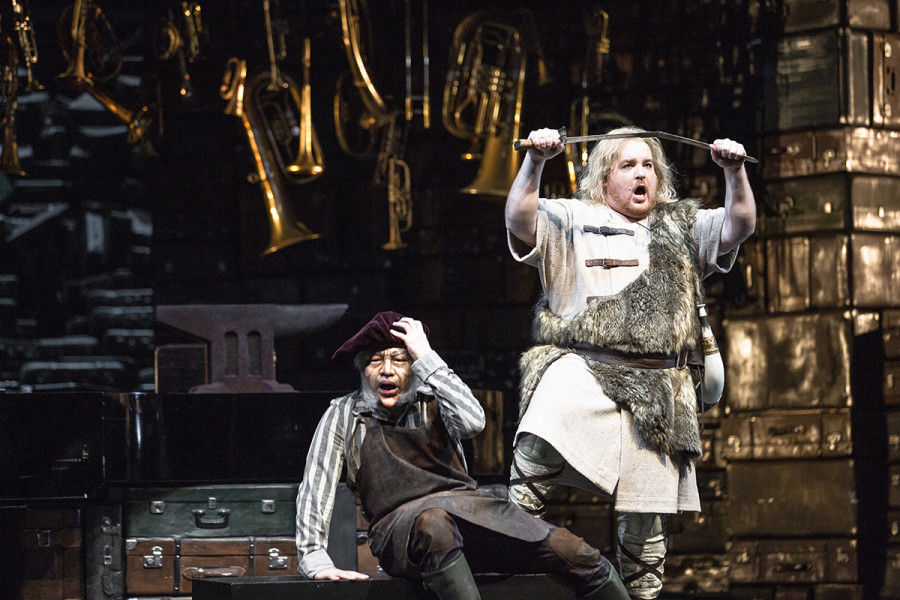


Stefan Herheim puede considerarse afortunado de contar, desde el estreno de esta producción, con un intérprete de Siegfried tan comprometido como Clay Hilley. Gracias a su cautivadora presencia escénica y a una fuerza vocal desbordante, no hay un solo instante de aburrimiento durante toda la velada. Especialmente la interacción con Ya-Chung Huang como Mime hace que, ya en el primer acto, uno olvide rápidamente lo débil que resulta el planteamiento dramático de la producción.
La mayor parte de la acción transcurre sobre o delante de la concha del apuntador, ya que ahora hay todavía más maletas apiladas alrededor del escenario que en La Walkiria. Más adelante, cantantes y figurantes deben abrirse paso por auténticas montañas de equipaje, una tarea tan incómoda como arriesgada. Igualmente problemáticas resultan varias acciones escénicas con enormes telas blancas. Estos paños, que cubren toda la embocadura del escenario, son izados, bajados y desplazados lateralmente, algo que podría generar un efecto visual impresionante. Sin embargo, prácticamente cada una de estas maniobras sale mal. Una de las telas llega a rozar la orquesta; Clay Hilley queda oculto precisamente durante la frase «Así corta la espada de Siegfried»; algunos figurantes están a punto de ser derribados; y al final una de las telas queda enganchada entre las maletas, obligando a Hilley a liberarla para que los técnicos puedan retirarla apresuradamente.
Todo ello no solo transmite una sensación de artificio y de falta de planificación técnica, sino que además, debido a sus constantes fallos, distrae de la acción dramática. Y eso que existen algunas ideas escenográficas realmente interesantes. Las altas torres de maletas se convierten en fuelles, el piano de concierto demuestra ser un elemento multifuncional y todo el escenario se transforma de manera espectacular en el gigante dragón Fafner, encarnado con una imponente autoridad vocal por Tobias Kehrer.
Solo algunos de los planteamientos conceptuales resultan verdaderamente convincentes. Así, Siegfried equipara desde el principio de forma muy explícita el concepto de «miedo» con el deseo sexual. También resulta conmovedora la idea de asignar el papel del Pájaro del Bosque a una voz de niño —Cornelius Park, con un timbre plateado y una excelente zona aguda—, ofreciendo así al huérfano Siegfried un breve encuentro simbólico con sus padres.
Menos acertado es el Fafner muerto que resucita repetidamente, mira a su alrededor desconcertado y vuelve a morir una y otra vez. La multitud copulando al final de la obra y los larguísimos cambios de escena —casi media hora más de lo anunciado, que ya eran 45 minutos— también restan considerable tensión dramática a la velada.
La dirección musical de Sir Donald Runnicles adolece igualmente de falta de tensión. Como suele ocurrir, el inicio está magníficamente construido, con una atmósfera plástica y misteriosa. Sin embargo, a partir de la referencia al «niño balbuceante», el espectador tiene la sensación de quedar sumido en un ininterrumpido andante y un constante mezzo forte. Algunos grupos instrumentales intentan aportar energía, pero el tempo pesado y parsimonioso termina frenándolos. Resulta significativo que, durante las canciones de la forja, Siegfried se suba a la concha del apuntador, “dirija” a la orquesta y se le escuche claramente decir: «¡Más rápido! ¡Más rápido!». Un deseo que probablemente compartía buena parte del público y que incluso parece una idea deliberada de la propia puesta en escena.
Clay Hilley posee una voz de tenor heroico brillante, formada en la tradición belcantista, pero demuestra además la inteligencia necesaria para no cantar toda la noche a plena potencia. Administra el largo papel con gran inteligencia, resolviendo de forma económica los extensos pasajes de los dos primeros actos mediante una emisión relajada, cercana al canto hablado. En el tercer acto conserva todavía tal frescura vocal que logra un extraordinariamente seductor diminuendo en el segundo «¡Despierta!». Incluso seis horas después del comienzo de la ópera, domina el gran dúo final con Brünnhilde con absoluta naturalidad.
Elisabeth Teige es una conmovedora Brünnhilde completamente humana. En este nuevo rol demuestra de nuevo el enorme talento que posee para dar un brillo exepcional a cualquier papel del espectro operístico.
Iain Paterson muestra dificultades evidentes en el registro medio y en ocasiones necesita aclararse la garganta, aunque sigue siendo capaz de brillar gracias a unos agudos seguros y firmes.
Ya-Chung Huang juega en una categoría aparte. Es un tenor de carácter consumado, heredero de la tradición de Stolze, Unger y Zednik, aunque aportando una personalidad propia muy definida. Con una dicción ejemplar, gran sentido teatral y aprovechando todos los recursos vocales a su alcance, se convierte, junto a Hilley, en la gran estrella de la noche.
Niklas Vogel


Comentarios