
La Traviata in a cabaret at Warsaw
La Traviata, Giuseppe Verdi
Polish National Opera in Warsaw
30 May 2026
Cast: Perrine Madoeuf, Bror Magnus Tødens, Mateusz Michałowski, Tomasz Rak, Katarzyna Szymkowiak
Conductor: Patrick Fournillier
Giuseppe Verdi’s masterpiece La Traviata is back for another season at the Polish National Opera House in Warsaw. The production, which premiered in 2010, was created by Mariusz Treliński and is still being performed today. For La Traviata, Treliński collaborated with the acclaimed stage designer Boris Kudlička, who is now the director of Warsaw Opera. For the show, Kudlička created different rooms that move across the stage, with a cabaret set at its centre. This forced the characters to move between the rooms, causing half of the action to take place on the side and evoking a certain discomfort for spectators watching from distant or side seats. The different rooms symbolised various stages or aspects of Violetta’s life. The more private ones were kept in warm colours, while the public ones, such as the cabaret stage, were always lit in blue.
The action began as we heard the first sounds of the overture. In the middle of the stage was a shiny silver coffin, with a disco ball hanging from the ceiling above it. As the music progressed, dancers appeared all around, and a woman in shiny, silver attire with long white feathers in her hair emerged from the coffin. As the first act began, the stage quickly transformed into a cabaret. Violetta was back, this time wearing a tight corset and a green, feathery cloak. In this production, Treliński transformed the courtesan into a failed artist, surrounded not by aristocrats as in the original libretto, but by her fans. This concept departed from the tragic story. By replacing the lavish parties with a cabaret, Treliński lost the sense of cynicism and moral corruption of high society, which was seemingly in awe of Violetta. However, there were still ignominious motifs. The cabaret normalised Violetta’s profession to an extent, particularly when compared to the half-naked dancers on stage.
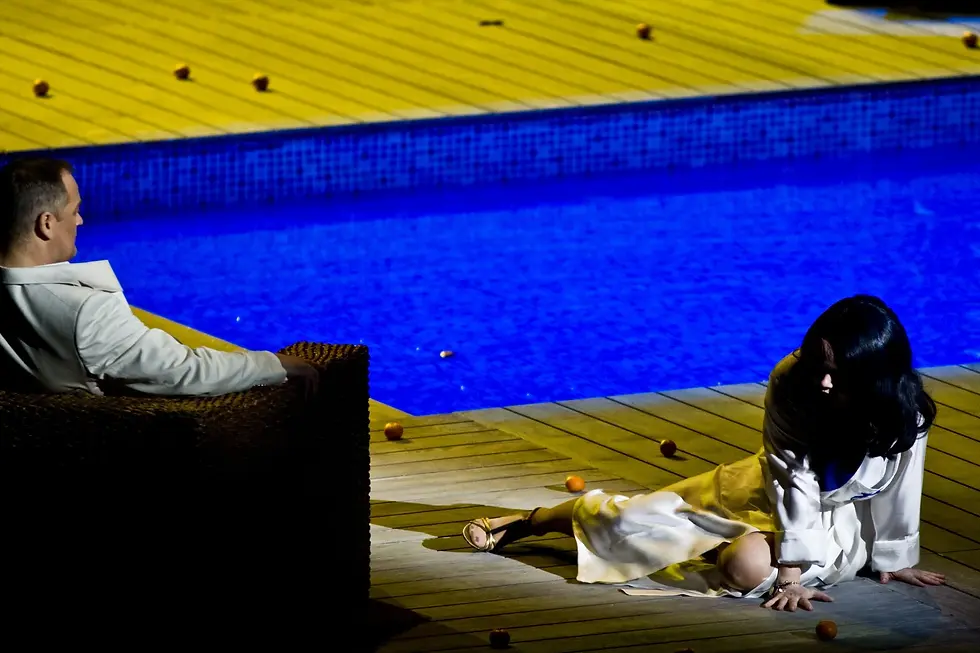
As the story continued, the party ended and left Violetta all alone in the dark. This is the moment when the aria É strano! É strano!... Ah, fors'è lui began. On 30 May, the “fallen woman” was portrayed by Perrine Madoeuf. The soprano stumbled through the first act. While she has a nice voice, she was more comfortable in the lower register and in more dramatic moments. Her biggest inaccuracy occurred in the final part of Sempre libera, where she was unable to sing the final note clearly. However, she was saved by the maestro, Patrick Fournillier, who drowned out her voice with the sound of the orchestra. The tenor Bror Magnus Tødens, playing Alfredo, also struggled with the performance. He did not perform badly; it was simply that their voices did not blend well together. This made Violetta and Giorgio Germont’s duet more memorable. The father was portrayed by the great baritone Mateusz Michałowski. As was announced before the show, he was vocally indisposed. I do believe that, without the announcement, nobody would have known: his voice was strong, and he had very good diction. The fact that he did not sing some of the higher notes was probably due to his illness. Giorgio Germont’s meeting with Violetta took place against the most appealing stage design. The set for the second act consisted of a swimming pool and a few chairs, and at the beginning of the act it was illuminated with an orange light, which muted the very strong blue of the first act.
After the break, we returned to the cabaret, which still deviated from the original idea of the grand balls. The following duets featured much better performances by both singers. The party ended, and we witnessed the end of Violetta’s life. In the third act, Perrine Madoeuf demonstrated her true acting capabilities, probably because she was finally free from the complicated sets and dance numbers. This time, the stage design consisted of nothing but a few mirrors and a chair emerging from the darkness. Violetta looked striking in a bright nightdress as she sang Addio del passato, resorting surprisingly to a scream in the middle of the aria. As her life slipped away, the disco ball from the first act appeared again, and, moments before collapsing, she reached for it as if trying to regain her old cabaret life. It is quite absurd, since at this point in the story, Violetta longs for love and a life with Alfredo – certainly not the career that drained her of her life.
The person who saved the show was the brilliant maestro, Patrick Fournillier, who tried to conceal the singers’ mistakes by making the music louder throughout. Yet, all things considered, it was an enjoyable show. However, it was not the grand production we are used to seeing at the MET by Michael Mayer or in Salzburg by Willy Decker. As we all know, La Traviata is a very difficult piece, especially for the soprano, so the audience was not surprised by the odd slip-up. Therefore, the show did make an impression, as La Traviata always does, and some audience members left the theatre in tears, having appreciated the story despite the director’s radical changes. Finally, the performance was met with a long standing ovation.
Iga Olszewska



La obra maestra de Giuseppe Verdi, La Traviata, ha regresado una temporada más al escenario de la Ópera Nacional de Polonia en Varsovia. La producción, estrenada en 2010, fue creada por Mariusz Treliński y continúa representándose en la actualidad. Para esta Traviata, Treliński colaboró con el prestigioso escenógrafo Boris Kudlička, hoy director de la Ópera de Varsovia. Kudlička diseñó para la producción una serie de habitaciones móviles que se desplazan por el escenario, con un cabaré situado en el centro del conjunto. Esto obligaba a los personajes a moverse constantemente entre los distintos espacios, haciendo que buena parte de la acción se desarrollara en los laterales del escenario y provocando cierta incomodidad para los espectadores situados en localidades alejadas o con visibilidad reducida. Las diferentes estancias simbolizaban diversas etapas o aspectos de la vida de Violetta. Los espacios más íntimos estaban bañados por colores cálidos, mientras que los públicos, como el escenario del cabaré, aparecían siempre iluminados en tonos azules.
La acción comenzó con los primeros compases de la obertura. En el centro del escenario se encontraba un brillante ataúd plateado, sobre el que colgaba una bola de discoteca. A medida que avanzaba la música, aparecieron bailarines por todo el escenario y una mujer vestida con un traje plateado y plumas blancas en el cabello emergió del ataúd. Cuando comenzó el primer acto, el escenario se transformó rápidamente en un cabaré. Violetta reapareció luciendo un corsé ajustado y una capa verde adornada con plumas. En esta producción, Treliński convirtió a la cortesana en una artista fracasada, rodeada no de aristócratas, como indica el libreto original, sino de admiradores. Este planteamiento se alejaba considerablemente de la historia trágica concebida por Verdi. Al sustituir las fastuosas fiestas por un cabaré, se perdió gran parte del cinismo y la corrupción moral de la alta sociedad, fascinada por Violetta en la obra original. Aun así, permanecían algunos elementos degradantes. El cabaré normalizaba hasta cierto punto la profesión de Violetta, especialmente cuando se comparaba con los bailarines semidesnudos que ocupaban el escenario.
Cuando la fiesta terminó, Violetta quedó sola en la oscuridad. Es entonces cuando comienza el aria È strano!... Ah, fors'è lui. El 30 de mayo, la protagonista fue interpretada por Perrine Madoeuf. La soprano atravesó el primer acto con dificultades. Aunque posee una voz agradable, se mostró más cómoda en el registro grave y en los momentos de mayor intensidad dramática. Su error más evidente se produjo en la parte final de Sempre libera, donde no logró emitir con claridad la nota conclusiva. Sin embargo, fue salvada por el maestro Patrick Fournillier, quien cubrió discretamente el problema aumentando el volumen de la orquesta. El tenor Bror Magnus Tødens, encargado del papel de Alfredo, también tuvo dificultades. No fue una mala actuación en sí misma, pero las voces de ambos cantantes no terminaban de empastar. Por ello, el dúo entre Violetta y Giorgio Germont resultó mucho más memorable. El padre de Alfredo fue interpretado por el gran barítono Mateusz Michałowski. Antes de la función se anunció que se encontraba indispuesto vocalmente. Sin embargo, de no haber mediado ese aviso, difícilmente alguien lo habría notado: su voz sonó firme y la dicción fue excelente. El hecho de que evitara algunas notas agudas probablemente se debió precisamente a esa indisposición. El encuentro entre Giorgio Germont y Violetta tuvo lugar en el espacio escénico más atractivo de toda la producción. El segundo acto se desarrollaba en torno a una piscina y unas pocas sillas, iluminadas al inicio por una cálida luz anaranjada que suavizaba el intenso azul dominante en el primer acto.
Tras el intermedio regresamos al cabaré, que seguía alejándose de la idea original de los grandes bailes de sociedad. Los dúos posteriores mostraron una notable mejoría por parte de ambos cantantes. La fiesta concluyó y asistimos al final de la vida de Violetta. En el tercer acto, Perrine Madoeuf demostró plenamente sus capacidades dramáticas, probablemente porque por fin se vio liberada de la complejidad de la escenografía y de los números coreográficos. Esta vez el escenario se reducía a unos pocos espejos y una silla emergiendo de la oscuridad. Violetta aparecía impactante con un camisón claro mientras cantaba Addio del passato, recurriendo incluso de manera sorprendente a un grito en mitad del aria. A medida que la vida se le escapaba, reaparecía la bola de discoteca del primer acto y, poco antes de desplomarse, intentaba alcanzarla como si quisiera recuperar su antigua existencia en el cabaré. La idea resulta bastante absurda, ya que en este punto de la historia Violetta anhela el amor y una vida junto a Alfredo, no precisamente la carrera que ha consumido su existencia.
Quien realmente salvó la representación fue el brillante maestro Patrick Fournillier, que trató de disimular los errores de los cantantes aumentando la intensidad sonora de la orquesta cuando era necesario. Considerándolo todo, la función resultó disfrutable. Sin embargo, no alcanzó la categoría de las grandes producciones a las que estamos acostumbrados en el Metropolitan Opera con Michael Mayer o en Salzburgo con Willy Decker. Como bien sabemos, La Traviata es una obra extremadamente exigente, especialmente para la soprano protagonista, por lo que el público no se mostró sorprendido ante algunos fallos puntuales. Aun así, la representación dejó huella, como suele suceder siempre con La Traviata, y algunos espectadores abandonaron el teatro entre lágrimas, emocionados por la historia a pesar de los radicales cambios introducidos por el director de escena. Finalmente, la función fue recibida con una larga ovación en pie.
Iga Olszewska


Comentarios