
Fiennes Eugene Onegin
Eugene Onegin, Pyotr Ilyich Tchaikovsky
Opéra de Paris, Palais Garnier, Paris
One of the most anticipated premieres of the year in Paris was Alexander Neef's ambitious bet for an Eugene Onegin directed by the Hollywood star Ralph Fiennes. The event generated such excitement that, "magically", the tickets vanished on the first day they went on sale, although they quickly reappeared on secondary websites at triple the price and some performances were only for VIPs. No one dares to speak the truth, because these aren't times for that, and flattery in the opera world, especially when one wants to be "in fashion", demands that Fiennes' production be described as extraordinary.
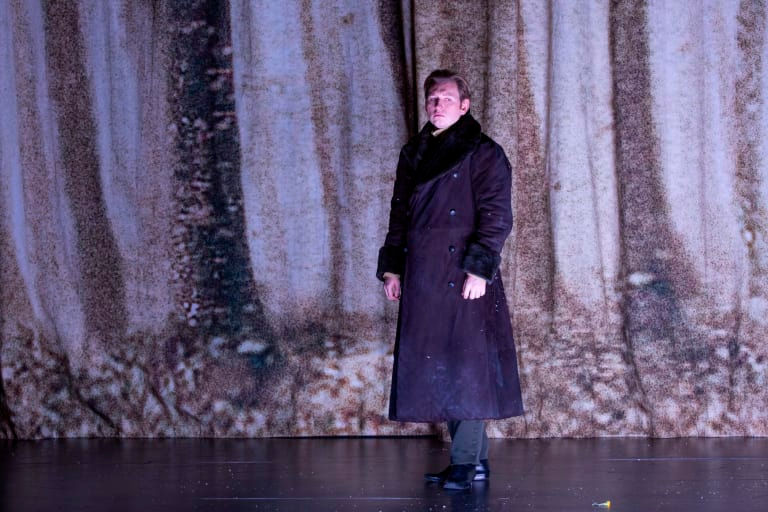
So what can one say about such a highly publicized event? Did Ralph Fiennes, with his immense talent, truly deliver such a fairy tale in the purest traditional style, with sets seemingly straight out of the Tsarist era? Antique-style sets, but printed. They could have at least asked the Opera di Roma's painting workshop to paint them. Not even that. Frankly, one expected much more from a major Hollywood star in his first production; it was neither demanding nor ingenious. The Nozze di Figaro, which was performed there a few months ago, was far more impressive in the staging. Certainly, the great dramatic work that Fiennes' team did with the singers and the entire cast of extras and dancers was evident, but the visual aspect offered nothing new and much more was expected. The one who truly did an extraordinary job was Annemarie Woods with the costumes, which were supremely delicate and brilliant. And the other positive aspect of the production was Alessandro Carletti's lighting, which gave the most powerful dramatic touch to the otherwise rather unattractive sets.
The great triumph of this production was the Ukrainian tenor Bogdan Volkov, whose Lensky was stellar, unique, and innovative. His velvety voice, with its unparalleled dramatic richness and crystalline, exquisitely delicate high notes, gifted us with a Lensky that marks a turning point in the interpretation of this fundamental role of the Russian repertoire. His rendition of "Куда, куда, куда вы удалились" proved to be one of the most exciting and vibrant moments of the evening, with excellent phrasing and legato worthy of the great legends of opera, as Volkov will soon be.
Boris Pinkasovich's already well-known Onegin was also at an exceptionally high level, with vocal power and a supremely enchanting lyrical timbre. His voice imbued us with musicality and romanticism from the very first aria of the first act. Ruzan Mantashyan also sang a perfect Tatiana, clear throughout her extensive vocal range and vocally very seductive. Her interpretation of the celebrated aria "Пускай погибну я, но прежде" was of an exceptionally high standard.
Marvic Monreal's Olga was excellent; her voice is an acoustic marvel in the deepest registers, while at the same time achieving precise and powerful high notes. Alexander Tsymbalyuk was a profound, combative, and dramatic Prince Gremin, with a warm and brilliant voice. Susan Graham, Elena Zaremba, and Amin Ahangaran stood out for their technical skill and dramatic presence.
Semyon Bychkov, conducting, delivered a passionate, romantic, and faithful interpretation of the score, as well as one that was measured and rich in nuance. The Paris Opera Orchestra sounded better than ever.
Dr. Eloi de Tera


Uno de los estrenos más esperados de este año en Paris, era la gran apuesta de Alexander Neef por un Eugene Onegin con puesta en escena del hollywoodiense Ralph Fiennes. Tal expectación generó el evento que, "mágicamente", las entradas desaparecieron al primer día de ponerse a la venta, aunque enseguida aparecieron en webs secundarias con el precio triplicado. Nadie se atreverá a decir la verdad, porque no corren los tiempos para eso y la adulación en el mundo de la ópera, sobre todo, cuando se quiere estar "a la moda" exige decir que el evento de Fiennes fue extraordinario.
¿Pues que se puede decir de un evento tan anunciado a bombo y platillo? ¿De verdad, Ralph Fiennes, con su enorme talento, nos ha traído tal cuento de hadas en el más puro estilo tradicional con decorados casi salidos de la época de los zares? Decorados al estilo antiguo pero impresos. Podrían haber pedido al taller de pintura de la Opera di Roma que se los pintaran, por lo menos. Ni eso. Sinceramente, de una gran estrella de Hollywood en el concepto se esperaba muchísimo más, esta producción no fue nada exigente ni ingeniosa. Lo eran mucho más Le Nozze di Figaro que se vieron allí mismo hace unos meses. Ciertamente, se notó el gran trabajo dramático que el equipo de Fiennes hizo con los cantantes y con todo el cuerpo de figuración y baile, pero la parte visual no aportó nada nuevo y se esperaba mucho más. Quien realmente hizo una labor extraordinaria fue Annnemarie Woods con el vestuario que era de una delicadeza y brillantez supremas. Y, el otro punto positivo de la producción fue la iluminación de Alessandro Carletti que daba el punto más potente de dramatismo a los poco atractivos decorados.
El gran triunfador fue el tenor ucraniano Bogdan Volkov, cuyo Lensky es sideral, único y novedoso. Su voz de terciopelo, con un cáliz dramático inigualable, unos agudos cristalinos y delicadísimos, nos regaló un Lensky que supone un antes y un después en la interpretación de este rol fundamental del repertorio ruso. Su interpretación de "Куда, куда, куда вы удалились" resultó ser uno de los momentos más emocionantes y vibrantes de la velada, con un fraseo y un legato excelentes y dignos de los grandes mitos de la ópera, como lo será pronto Volkov.
El ya conocido Oneguin de Boris Pinkasovich estuvo a un altísimo nivel también, con una fuerza vocal y un color lírico supremamente encantador. Su voz nos impregnó de musicalidad y romanticismo ya desde el aria del primer acto. Ruzan Mantashyan cantó asimismo una Tatiana perfecta, limpia en todo su registro vocal extenso y muy seductora vocalmente. Su interpretación de la celebérrima aria "Пускай погибну я, но прежде" estuvo a un nivel altísimo.
La Olga de Marvic Monreal resultó excelente, su voz es un prodigio acústico en los registros más profundos y, a la vez, consigue unos agudos precisos y potentes. Alexander Tsymbalyuk fue un príncipe Gremin profundo, combativo y dramático, con una voz cálida y brillante. Destacaron las voces de Susan Graham, Elena Zaremba y Amin Ahangaran por sus dotes técnicas y su presencia dramática.
Semyon Bychkov al frente de la dirección musical, supo ofrecernos una lectura apasionada, romántica y fiel a la partitura, así como muy medida y rica en matices. La orquesta de la Opéra de Paris sonó mejor que nunca.
Dr. Eloi de Tera


Comentarios