
Falstaff Premiere in Warsaw
Falstaff, Giuseppe Verdi
The Polish National Opera, Warsaw
17.04.2026
Principal cast:
Sergio Vitale, Stanislav Kuflyuk, Aleksandra Orłowska, Hanna Sosnowska-Bill, Deniz Uzun, Monika Ledzion-Porczyńska,, conductor: Patrick Fournillier
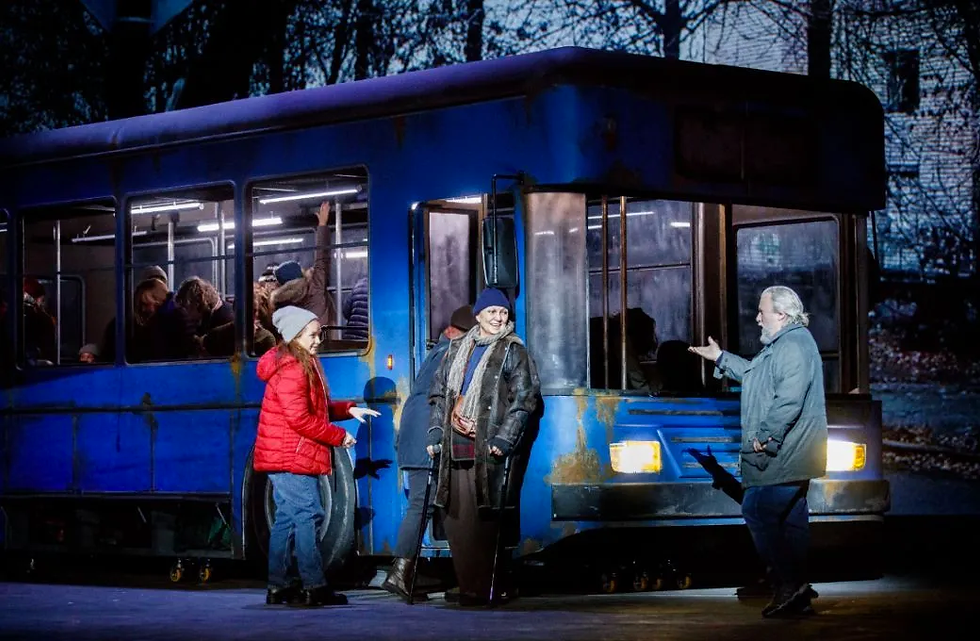
Falstaff, Verdi’s last opera, was also the final production directed by Marek Weiss. This opera is incredibly difficult to stage and had its premiere on 17 April 2026 at the Polish National Opera House. Weiss took a new approach, transporting the action of the opera to the modern world. Yet he retained some of the fantastic Shakespearean imagery. In this way, the director created a complex world in which the opera unfolds.
The curtain rose and the overture began. Henry IV appeared on stage, and, once crowned by the archbishop, pushed Falstaff away. All the characters were led by dancers into a reality that gradually became part of the modern world. The first act began, revealing an interior of a nightclub to the spectators. In the middle of the stage was a 'golden calf' idol, clearly nodding to the 'horns' often mentioned in the score. Then Falstaff, portrayed by Sergio Vitale, appeared on stage. The singer amazed the audience with his great comedic timing and resonant voice. However, the Falstaff in Warsaw was a different character from the usual funny fat guy in Verdi's operas. This time, Falstaff was depicted as a horrible person who was somewhat aware of his wrongdoings. As the action of the opera progressed, other characters appeared on stage, and soon it was full of singers and dancers enjoying themselves in the nightclub. Consequently, the scene became somewhat chaotic and messy, but such a composition seemed fitting for a comic opera.
The second act began at Alice's house, where four women were planning to play a trick on Falstaff. This scene gave the four female singers an opportunity to demonstrate their vocal abilities. And they took full advantage of it. The four performers were: Aleksandra Orłowska, Monika Ledzion-Porczyńska, Hanna Sosnowska-Bill and Deniz Uzun — and all showcased their incredible talent. Aleksandra, playing Alice, filled every corner of the theatre with her beautiful soprano voice. Deniz Uzun, portraying Mrs Quickly, amazed everyone with her acting and, despite being a mezzo-soprano, sang the part traditionally written for a contralto perfectly. Hanna Sosnowska-Bill presented the role of Nannetta beautifully, particularly in her third-act aria. Last but not least, Monika Ledzion-Porczyńska gave a brilliant performance as Meg.
The interiors of Alice's house were well illuminated throughout the scene, giving the audience an opportunity to take a closer look at the costumes. Through the costumes, fashion designers Marcin Paprocki and Mariusz Brzozowski revealed the characters’ personalities and their roles in the story. While not over the top, they remained tasteful.
In the third act, the action concluded against a huge oak tree, as written in the score. The tree made a great impression as it slowly approached the spectators, emerging from the darkness to become the centrepiece of Wiesław Olko's stage design.
As the finale began, the audience saw a dancer dressed all in white with horns on his head — the central motif of the opera reappeared. He was soon joined by the archbishop from the opening scene, as if guiding the audience through the story. Then the other cast members and the choir came onto the stage. The entire choir wore black, as if in mourning, awaiting tragedy. This added a dramatic quality to the scene, especially when contrasted with the dancer's white costume. Surprisingly, the opera ended with Falstaff’s death, unlike the original score. Marek Weiss’s decision to kill the main character while the others were mocking and amusing themselves added a bittersweet feeling to the opera. Falstaff slowly died at the centre of the stage while the orchestra, conducted by the brilliant Patrick Fournillier, played the final chords.
Iga Olszewska


Falstaff, la última ópera de Verdi, fue también la producción final dirigida por Marek Weiss. Esta ópera es increíblemente difícil de poner en escena y tuvo su estreno el 17 de abril de 2026 en la Ópera Nacional de Polonia. Weiss adoptó un enfoque nuevo, trasladando la acción de la ópera al mundo moderno. Sin embargo, conservó parte de la imaginería fantástica shakesperiana. De este modo, el director creó un mundo complejo en el que se desarrolla la ópera.
Se alzó el telón y comenzó la obertura. Enrique IV apareció en escena y, una vez coronado por el arzobispo, apartó a Falstaff. Todos los personajes fueron conducidos por bailarines hacia una realidad que gradualmente se convirtió en parte del mundo moderno. El primer acto comenzó, mostrando a los espectadores el interior de una discoteca. En el centro del escenario había un ídolo de “becerro de oro”, aludiendo claramente a los “cuernos” mencionados con frecuencia en la partitura. Entonces Falstaff, interpretado por Sergio Vitale, apareció en escena. El cantante asombró al público con su gran sentido cómico y su voz resonante. Sin embargo, el Falstaff de Varsovia era un personaje diferente del típico gordo gracioso de las óperas de Verdi. Esta vez, Falstaff fue retratado como una persona horrible que era, en cierto modo, consciente de sus malas acciones. A medida que avanzaba la acción, otros personajes aparecieron en escena y pronto se llenó de cantantes y bailarines divirtiéndose en la discoteca. En consecuencia, la escena se volvió algo caótica y desordenada, pero tal composición parecía adecuada para una ópera cómica.
El segundo acto comenzó en la casa de Alice, donde cuatro mujeres planeaban gastar una broma a Falstaff. Esta escena brindó a las cuatro cantantes la oportunidad de demostrar sus capacidades vocales, y la aprovecharon al máximo. Las cuatro intérpretes fueron: Aleksandra Orłowska, Monika Ledzion-Porczyńska, Hanna Sosnowska-Bill y Deniz Uzun, y todas mostraron su increíble talento. Aleksandra, en el papel de Alice, llenó cada rincón del teatro con su hermosa voz de soprano. Deniz Uzun, interpretando a Mrs Quickly, asombró a todos con su actuación y, a pesar de ser mezzosoprano, cantó perfectamente un papel tradicionalmente escrito para contralto. Hanna Sosnowska-Bill presentó el papel de Nannetta de forma magnífica, especialmente en su aria del tercer acto. Por último, pero no menos importante, Monika Ledzion-Porczyńska ofreció una brillante interpretación como Meg.
Los interiores de la casa de Alice estuvieron bien iluminados durante toda la escena, lo que permitió al público observar con más detalle el vestuario. A través de los trajes, los diseñadores Marcin Paprocki y Mariusz Brzozowski revelaron la personalidad de los personajes y sus roles en la historia. Sin ser exagerados, resultaban elegantes.
En el tercer acto, la acción concluyó frente a un enorme roble, tal como indica la partitura. El árbol causó una gran impresión al acercarse lentamente a los espectadores, emergiendo de la oscuridad para convertirse en la pieza central de la escenografía de Wiesław Olko.
Al comenzar el final, el público vio a un bailarín vestido completamente de blanco con cuernos en la cabeza: el motivo central de la ópera reaparecía. Pronto se le unió el arzobispo de la escena inicial, como si guiara al público a través de la historia. Luego, los demás miembros del reparto y el coro entraron en escena. Todo el coro vestía de negro, como de luto, esperando una tragedia. Esto añadió una cualidad dramática a la escena, especialmente en contraste con el traje blanco del bailarín. Sorprendentemente, la ópera terminó con la muerte de Falstaff, a diferencia de la partitura original. La decisión de Marek Weiss de matar al personaje principal mientras los demás se burlaban y se divertían añadió un tono agridulce a la ópera. Falstaff murió lentamente en el centro del escenario mientras la orquesta, dirigida por el brillante Patrick Fournillier, interpretaba los acordes finales.
Iga Olszewska


Comentarios