
Elektra at the Bayerische Staatsoper
Elektra | Bayerische Staatsoper | 18.3.26
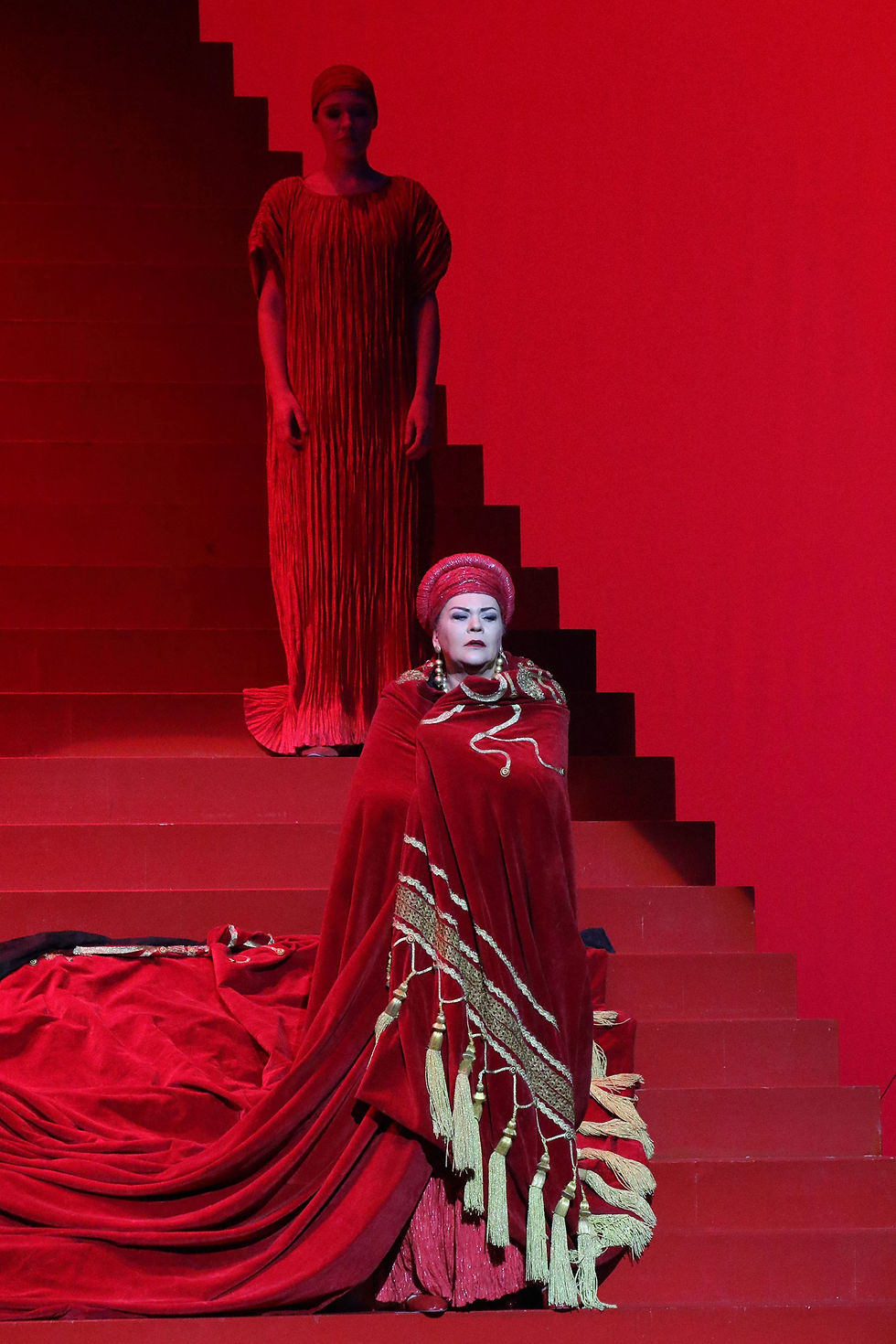
With the revival of Elektra in the staging by Herbert Wernicke, the Bavarian State Opera once again demonstrates how timeless an intelligent, radically reduced production can be. Created in 1997, this interpretation still feels strikingly contemporary today—precisely because of its uncompromising focus on minimalism and acting. All the more radical, then, is Wernicke’s ending: Elektra does not die in an ecstatic dance, but chooses to take her own life—an uncompromising and deeply unsettling conclusion.
Musically, the evening is shaped above all by Vladimir Jurowski, who leads the Bavarian State Orchestra with an interpretation of extraordinary intensity—one can clearly sense that he knows the score extremely well by now. Strauss’ music appears here in all its modernity: sharp dissonances, eruptive orchestral outbursts, and fragile, almost chamber-like moments alternate continuously. Jurowski succeeds in shaping these extremes with great precision while never losing sight of the overarching dramatic arc.
Even though the casting of the evening, prior to the revival, was announced with several changes (originally scheduled were Christine Goerke, Vida Miknevičiūtė, and Nina Stemme), the result turned out to be an even stronger cast than expected. At the center of the ensemble stands Elena Pankratova as Elektra. With enormous vocal power and remarkable stamina, she shapes the role as an obsessive psychological portrait, oscillating between frenzy and inner fragmentation. Her interpretation is not only defined by sheer volume, but above all by her ability to render extreme emotional states with subtle differentiation. As Chrysothemis, Sinéad Campbell-Wallace provides a clear contrast: her bright, well-focused soprano gives the character a touching humanity and a deep longing for a different life—a very strong house debut at the Nationaltheater, and hopefully the beginning of further appearances in Munich. Violeta Urmana, an audience favorite following her recent appearances (such as Pique Dame and The Night Before Christmas), is always a pleasure to see again and convinces as Klytämnestra with an intense portrayal oscillating between authority and inner decay. In the supporting roles, Charles Workman stands out as Aegisth, making a strong impression despite the brevity of the role. Iain Paterson was the only one this evening who does not fully convince, neither vocally nor dramatically.
The audience responded with enthusiastic applause to an evening that once again demonstrates that great opera does not require superficial updates. Wernicke’s production draws its strength precisely from reduction—and reveals Elektra as what it truly is: an existential drama of timeless intensity.
Anja von Roßmann



Comentarios