
Vom Grünen ins Graue
- Veit Störmer
- hace 2 días
- 7 min de lectura
La Traviata, Giuseppe Verdi
Gärtnerplatztheater München
4. Juni 2026
Conductor: Rubén Dubrovsky
Orchestra: Orchester des Staatstheaters am Gärtnerplatz
Production: Isabel Ostermann
Violetta Valéry: Jennifer O’Loughlin, Alfredo Germont: Lucian Krasznec, Giorgio Germont: Mathias Hausmann, Flora Bervoix: Anna Tetruashvili, Annina: Anna Agathonos
La Traviata gehört zu den bekanntesten Opern überhaupt. Gerade deshalb ist es oft schwierig, ihr auf der Bühne neue Facetten abzugewinnen. Die Inszenierung von Isabel Ostermann am Gärtnerplatztheater versucht dies nicht durch große Regieeinfälle, sondern durch eine konsequent nach innen gerichtete Personenführung. Das Ergebnis ist eine werknahe, stimmige und emotional überzeugende Aufführung, die zwar nicht die tiefsten Deutungsebenen freilegt, dafür aber die menschliche Tragödie der Violetta klar und berührend erzählt.
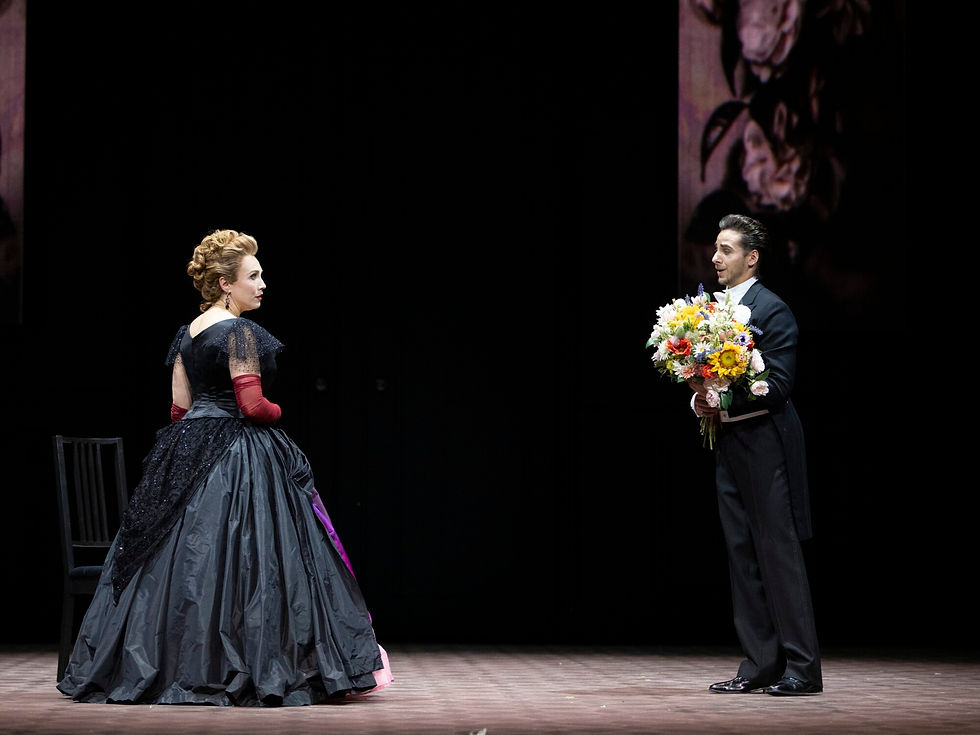
Besonders gelungen ist dabei der Kontrast zwischen dem ländlichen Idyll des zweiten Aktes und der Großstadtwelt, die zunehmend von Krankheit, Einsamkeit und Hoffnungslosigkeit geprägt wird. Je weiter die Handlung voranschreitet, desto mehr legt sich eine Schwärze über die Bühne. Gerade im letzten Akt entsteht so eine bedrückende Atmosphäre, die den tragischen Ausgang wirkungsvoll vorbereitet. Die Regie vertraut dabei ganz auf Verdis Werk und seine Figuren. Das mag nicht immer überraschend sein, funktioniert aber über weite Strecken sehr gut.
Auch musikalisch setzte der Abend auf Feinzeichnung statt auf große Effekte. Rubén Dubrovsky dirigierte das Orchester des Staatstheaters am Gärtnerplatz mit einem ausgesprochen kammermusikalischen Ansatz. Der Klang blieb durchsichtig und flexibel, zahlreiche Farben der Partitur wurden hörbar gemacht. Besonders gelungen war der ständige Austausch zwischen Bühne und Graben, sodass Sänger und Orchester nie gegeneinander arbeiteten, sondern gemeinsam die dramatischen Bögen entwickelten.
Jennifer O’Loughlin als Violetta benötigte einige Zeit, um vollständig in die Rolle hineinzufinden. Im ersten Akt wirkte ihre Darstellung stellenweise noch etwas blass und vorsichtig. Im Verlauf des Abends gewann sie jedoch zunehmend an Profil. Vor allem im letzten Akt überzeugte sie mit großer dramatischer Intensität, einem durchsetzungsfähigen Klang und berührender Gestaltung. Ihre Violetta entwickelte sich im Laufe des Abends spürbar und fand gerade dort ihre stärksten Momente, wo Verdi die Figur an ihre emotionalen Grenzen führt.
Lucian Krasznec bildete mit ihr ein glaubwürdiges und sympathisches Liebespaar. Sein Alfredo beeindruckte zunächst mit sehr schön geführtem Tenor und großer Präsenz in den lyrischen Passagen. Besonders zu Beginn des Abends gelang ihm eine Reihe von Momenten, in denen die Stimme frei und strahlend wirkte. Allerdings schien ihn dieser kraftvolle Einstieg einiges an Reserven zu kosten. Im weiteren Verlauf verlor die Stimme
zunehmend an Leuchtkraft in der Höhe, wodurch die Figur etwas von ihrer emotionalen Wirkung einbüßte.
Der eigentliche gesangliche Höhepunkt des Abends war jedoch Mathias Hausmann als Giorgio Germont. Mit seiner wunderbar klaren Baritonstimme zog er die Aufmerksamkeit immer wieder auf sich. Die Stimme besitzt eine dunkle, edle Färbung, bleibt dabei aber stets lyrisch geführt und vermeidet jede grobe Autorität. Gerade dadurch gewann seine Darstellung an Größe. Hausmann gelang ein Germont, der nicht als bloßer Gegenspieler erscheint, sondern als Mensch mit Überzeugungen und inneren Konflikten. Seine Auftritte strahlten eine beeindruckende Ruhe und Würde aus.
In den kleineren Rollen hinterließen vor allem Anna Agathonos als Annina mit ihrem warmen Mezzo sowie Anna Tetruashvili als Flora einen positiven Eindruck, auch wenn Flora szenisch etwas blass blieb.
Am Ende bleibt eine solide bis sehr gute Traviata, die ihre Stärken weniger in spektakulären Regieideen als in der sorgfältigen musikalischen und darstellerischen Arbeit findet. Die Inszenierung erzählt die Geschichte klar und nachvollziehbar, das Dirigat überzeugt durch Transparenz und Farbenreichtum, und mit Mathias Hausmann steht ein Giorgio Germont auf der Bühne, der dem Abend seinen Stempel aufdrückt. Keine revolutionäre Neudeutung, aber eine ehrliche und musikalisch überzeugende Aufführung von Verdis Meisterwerk.
Veit Störmer

La Traviata is one of the most famous operas ever written. Precisely for that reason, it is often difficult to uncover new facets of the work on stage. Isabel Ostermann’s production at Munich’s Gärtnerplatztheater does not attempt this through radical reinterpretation, but rather through a consistently introspective approach to the characters. The result is a faithful, coherent, and emotionally engaging performance that may not reveal profound new layers of meaning, yet succeeds in telling Violetta’s tragedy with clarity and sincerity.
Particularly effective is the contrast between the pastoral idyll of the second act and the urban world increasingly dominated by illness, loneliness, and despair. As the evening progresses, darkness gradually settles over the stage. By the final act, this creates an oppressive atmosphere that powerfully prepares the audience for the inevitable tragedy. The staging places its trust in Verdi’s score and characters. While not always surprising, it proves highly effective throughout most of the evening.
Musically, the performance favored refinement over spectacle. Rubén Dubrovsky led the orchestra of the Staatstheater am Gärtnerplatz with a distinctly chamber-like approach. The sound remained transparent and flexible, allowing many of Verdi’s orchestral colors to
emerge clearly. Particularly impressive was the constant dialogue between stage and pit, ensuring that singers and orchestra worked together in shaping the drama.
Jennifer O’Loughlin’s Violetta required some time to settle fully into the role. In the first act, her performance occasionally seemed cautious and somewhat pale. As the evening progressed, however, she grew steadily in confidence and presence. By the final act, she delivered a deeply moving portrayal, combining dramatic intensity with a voice capable of cutting through the orchestral texture. Her strongest moments came precisely where Verdi pushes the character to her emotional limits.
Lucian Krasznec formed a convincing and sympathetic partnership with her as Alfredo. His tenor sounded particularly attractive at the beginning of the evening, with notable freedom and brightness in the lyrical passages. Yet the strong start appeared to take its toll. As the performance continued, the upper register gradually lost some of its brilliance, slightly diminishing the character’s impact.
The vocal highlight of the evening was undoubtedly Mathias Hausmann as Giorgio Germont. With his beautifully clear baritone, he repeatedly commanded attention whenever he appeared on stage. The voice possesses a dark, noble coloration while remaining fundamentally lyrical in approach, avoiding any hint of excessive authority. This gave his portrayal unusual depth and dignity. Hausmann presented Germont not merely as an antagonist, but as a man guided by conviction and inner conflict. His performance radiated calm, elegance, and humanity.
Among the smaller roles, Anna Agathonos made a strong impression as Annina with her warm mezzo-soprano, while Anna Tetruashvili’s Flora sang attractively despite the limited opportunities offered by the role.
In the end, this was a solid to very good Traviata, distinguished less by spectacular directorial ideas than by careful musical and dramatic craftsmanship. The production tells the story clearly and effectively, the conducting impresses through transparency and color, and Mathias Hausmann’s Giorgio Germont emerges as the evening’s defining performance. Not a revolutionary reinterpretation, but an honest and musically rewarding account of Verdi’s masterpiece.
Veit Störmer


La Traviata es una de las óperas más famosas de todos los tiempos. Precisamente por ello, no resulta fácil descubrir nuevos matices de la obra sobre el escenario. La producción de Isabel Ostermann en el Gärtnerplatztheater de Múnich no busca hacerlo mediante una reinterpretación radical, sino a través de un enfoque profundamente introspectivo de los
personajes. El resultado es una representación fiel, coherente y emocionalmente convincente que, aunque no ofrece lecturas especialmente profundas, logra narrar con claridad y sensibilidad la tragedia de Violetta.
Especialmente logrado resulta el contraste entre el idilio campestre del segundo acto y el mundo urbano, cada vez más dominado por la enfermedad, la soledad y la desesperanza. A medida que avanza la función, una creciente oscuridad se apodera del escenario. En el tercer acto, esta atmósfera opresiva prepara de manera muy eficaz el desenlace trágico. La dirección escénica confía plenamente en la música de Verdi y en la fuerza de sus personajes. Puede que no siempre sorprenda, pero funciona con notable eficacia.
En el aspecto musical, la velada apostó por la sutileza antes que por el espectáculo. Rubén Dubrovsky dirigió a la orquesta del Staatstheater am Gärtnerplatz con un enfoque claramente camerístico. El sonido fue transparente y flexible, permitiendo apreciar numerosos colores de la partitura verdiana. Especialmente destacable fue el constante diálogo entre el escenario y el foso, que permitió que cantantes y orquesta construyeran juntos el desarrollo dramático.
Jennifer O’Loughlin necesitó algo de tiempo para asentarse plenamente en el papel de Violetta. Durante el primer acto, su interpretación pareció por momentos algo cautelosa y discreta. Sin embargo, fue creciendo a lo largo de la representación. En el último acto ofreció una actuación de gran intensidad dramática, con una voz capaz de imponerse y una expresividad profundamente conmovedora. Sus mejores momentos llegaron precisamente cuando Verdi lleva al personaje al límite de sus emociones.
Lucian Krasznec formó junto a ella una pareja escénica convincente y entrañable. Su Alfredo destacó inicialmente por un tenor bien proyectado y luminoso, especialmente en los pasajes más líricos. Sin embargo, aquel brillante comienzo pareció pasar factura. A medida que avanzó la función, la voz fue perdiendo parte de su brillo en el registro agudo, lo que redujo ligeramente el impacto del personaje.
El gran protagonista vocal de la noche fue, sin duda, Mathias Hausmann como Giorgio Germont. Su hermoso barítono de gran claridad atrajo la atención cada vez que aparecía en escena. La voz posee una coloración oscura y noble, pero siempre mantiene un enfoque lírico que evita cualquier exceso de autoridad. Gracias a ello, su interpretación adquirió una gran dignidad y profundidad. Hausmann presentó a Germont no como un simple antagonista, sino como un hombre movido por convicciones y conflictos internos. Su actuación transmitió serenidad, elegancia y humanidad.
Entre los papeles secundarios destacaron Anna Agathonos como Annina, gracias a la calidez de su mezzo, y Anna Tetruashvili como Flora, que dejó una impresión positiva pese a la brevedad de su intervención.
En conjunto, esta fue una Traviata sólida y, por momentos, muy notable. Sus virtudes no radican en una puesta en escena revolucionaria, sino en la calidad de su trabajo musical y dramático. La producción cuenta la historia con claridad y eficacia, la dirección musical convence por su transparencia y riqueza de colores, y el Giorgio Germont de Mathias Hausmann termina siendo la actuación que marca la velada. No es una reinvención de la
obra, perosíuna interpretaciónhonestaymusicalmentesatisfactoriade laobramaestrade Verdi.
Veit Störmer


Comentarios