
Siegfried at Santa Cecilia: Musical Grandeur, Scenic confusion
Siegfried, Richard Wagner
Accademia Nazionale di Santa Cecilia, Auditorio Parco della Musica, Roma
21 October 2026
Voices: Michael Volle, Anna Kissjudit, Lysa Menu, Falck Struckmann, Clay Hilley, Elisabeth Strid, Wolfgang Koch, Wolfgang Ablinger-Sperrhacke. Conductor: Daniel Harding. Director: Vincent Huguet.
Yesterday, the Accademia Nazionale di Santa Cecilia once again made history by opening its season with a new staged production of Richard Wagner’s Siegfried, continuing the ambitious project that last year brought Die Walküre to the stage. This is a truly exceptional achievement, for few musical institutions without virtually unlimited financial resources can afford to undertake a staged production of a Wagner opera, let alone one of the monumental instalments of Der Ring des Nibelungen. This is undoubtedly Santa Cecilia’s greatest accomplishment: having dared to embark upon a project of such magnitude, even if it remains an incomplete Ring, since Das Rheingold has not been presented in a staged production.
It is worth remembering, however, that Wagner conceived the music of Der Ring des Nibelungen with a very specific intention: to put into practice the aesthetic and dramatic principles he had developed in his essay Oper und Drama. His conception of the total work of art demanded an entirely particular relationship between music, words, dramatic action, and theatrical space. The music was conceived for a very specific setting: a theatre in which the orchestra would remain partially concealed in the pit while the singers performed on stage. This arrangement, brought to its fullest realisation at the Bayreuth Festspielhaus, allows the extraordinary monumentality of Wagner’s orchestral writing to unfold without overwhelming the singers’ voices.
When the operas of the Ring are performed in concert versions or semi-staged productions without a proper orchestra pit, problems of acoustic balance become almost inevitable. And the Sala Santa Cecilia at the Auditorium Parco della Musica is certainly not the most suitable venue for staging a work of this nature. Its acoustics, magnificent for so many other repertoires, become an obstacle here: at numerous moments, the orchestral mass ends up covering the voices, preventing both the text and the vocal line from reaching the audience with the necessary clarity. This is particularly regrettable when such an exceptional cast is assembled.
But the problems of this production extend well beyond the acoustic conditions.
Wagner constructed a mythological universe of extraordinary complexity, depth, and coherence. It was a world that had been taking shape in his imagination since his Dresden years and which, drawing upon the sources of Germanic mythology, ultimately became an entirely personal artistic and philosophical creation. Such a universe cannot accommodate just any reinterpretation. Or, more precisely, it can accommodate reinterpretations provided that they arise from a solid dramaturgical concept capable of engaging with the profundity of Wagner’s thought.
Unfortunately, the contemporary tendency to constantly reinvent the meaning of these works, as we have also witnessed in the Paris Ring, too often leads to productions that, beneath a veneer of originality, ultimately descend into complete nonsense.
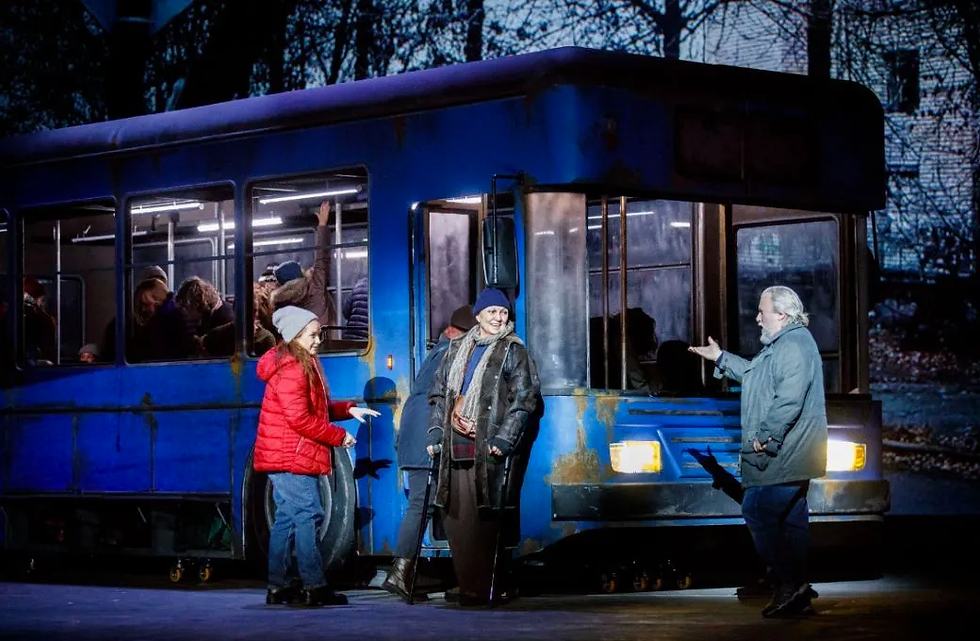
This is precisely what happens in Vincent Huguet’s production, with sets designed by Pierre Yovanovitch. The staging seems determined to reduce Wagner’s extraordinary universe to an accumulation of iconographic references drawn from Christianity, ancient Rome, and, at times, an imaginary world closer to the fairy tales of the Brothers Grimm than to any genuine reflection upon Germanic mythology.
The result is a bewildering catalogue of images whose relationship to the work proves impossible to decipher.
Mime appears dressed as some sort of Franciscan or Carmelite monk, while Wotan, transformed into the Wanderer, resembles a grand Benedictine or Carthusian abbot. What possible dramaturgical purpose is served by having these two characters apparently belong to different religious orders? What does such a distinction contribute to our understanding of their relationships, their conflicts, or their respective positions within Wagner’s universe?
Brünnhilde, meanwhile, appears dressed as a nun, perhaps a Poor Clare, who eventually removes her habit when Siegfried arrives. Alberich resembles a medieval crusader, while Fafner appears in a costume reminiscent of the angel in Giotto’s Annunciation. And then, just as we are beginning to convince ourselves that we have somehow found our way into an indeterminate world somewhere between the Middle Ages and the Renaissance, Erda suddenly appears at the top of a tower, like Rapunzel, and it is at precisely that moment that we become completely lost in this bewildering labyrinth of iconographic references.
The confusion reaches its climax in the final scene, when Siegfried awakens Brünnhilde, apparently lying inside a Roman sarcophagus. Yet she does not ultimately emerge from that sarcophagus, but rather from within a funerary structure that seems to hover somewhere between a monument by Canova and the Pyramid of Cestius.
Are we witnessing a meditation on death and resurrection? On Christianity and paganism? On the transformation of Germanic myth into a religious allegory? Or have we somehow, without realising it, wandered into one of the Brothers Grimm’s fairy tales? None of these possibilities is ever developed into anything remotely intelligible.
The whole thing ends up resembling one of those mannerist accumulations of images that might superficially recall the universe of David Lynch or certain sequences from La grande bellezza, but without the internal logic, symbolic force, or poetic coherence that justify those artistic visions.
Simply juxtaposing cultural references is not enough to construct a meaningful discourse. And when such scenic arbitrariness confronts the absolutely unquestionable monumentality of Wagner’s text, all that supposed visual sophistication ultimately dissolves into nothing.
It must also be said that, as was already the case with Die Walküre, the costumes created by Sartoria Trappeli are truly extraordinary and undoubtedly rank among the finest one can see on an operatic stage today. The exceptional quality of their craftsmanship, their attention to detail, and the sheer artistry of their work deserve the highest praise.
Daniel Harding and a Musically Colossal Siegfried
Fortunately, however, against this background of scenic confusion, we encountered a truly magnificent musical achievement under the leadership of Daniel Harding, whose conducting of Siegfried displayed extraordinary energy, monumentality, and control of tempo.
His interpretation can, without exaggeration, be placed among the great performances of this opera that we have had the privilege of hearing. Harding demonstrated a profound understanding of Wagner’s musical architecture, an admirable ability to sustain dramatic tension, and a command of proportion that allowed the immense score to unfold with exceptional naturalness and expressive force.
The evening, however, did not begin particularly auspiciously. A technical problem forced the performance to be interrupted shortly after it had begun and restarted from the very beginning, provoking the conductor’s visible irritation and prompting him to leave the stage. It was an unfortunate incident which, thankfully, did not affect what followed.
For once that setback had been overcome, we were able to experience a colossal Siegfried, one of those performances that remain indelibly engraved in the memory.
The orchestra of the Accademia Nazionale di Santa Cecilia played with impressive weight, cohesion, and harmonic richness. Harding achieved an admirable balance between the various instrumental sections, bringing out with extraordinary clarity the immensely complex web of motifs, colours, and tensions that constitutes Wagner’s orchestral writing.
There were moments of breathtaking sonic beauty, but also a monumentality that never became ponderous. The music breathed, moved forward, and found its own dramatic dimension in every episode. Only towards the end of the performance was there a certain tendency among the brass players to rush and partially lose control of their own sonic power. A minor imbalance which, in any case, did nothing to diminish the extraordinary standard achieved by the orchestra throughout the evening.
This magnificent orchestral achievement was complemented by a vocal cast of the highest calibre, capable of delivering performances of remarkable individuality and artistic quality.
First and foremost, Clay Hilley, whom we had already had the opportunity to hear in several other opera houses, including the Deutsche Oper Berlin, once again demonstrated that he possesses the qualities necessary to tackle one of the most demanding roles in the entire tenor repertoire. His Siegfried is powerful, expressive, full of energy, and endowed with a vocal and theatrical vitality that immediately connects with the audience. Hilley knows how to construct the character without losing sight of the score’s immense musical demands, offering an interpretation that truly honours Wagner’s writing.
Wolfgang Ablinger-Sperrhacke’s Mime was another of the evening’s great successes. His deliberately comic characterisation relied upon a distinctly nasal vocal quality, so appropriate to this character, and an extraordinary understanding of its many dimensions. His Mime was grotesque, ironic, unsettling, and profoundly theatrical, without ever descending into empty caricature. Here is a singer who knows how to discover the essence of a character and carry it to its fullest expressive potential.
Michael Volle, portraying Wotan in his guise as the Wanderer, once again delivered a simply monumental performance. Few artists possess such a profound identification with this character, and fewer still are capable of combining such dramatic authority with a vocal presence of this magnitude. At this stage in his career, Volle continues to offer interpretations that seem to defy the passage of time. His Wotan remains an absolute benchmark, one of the greatest we have ever heard, and in Rome he once again stood among the most impressive voices of the entire evening. His command of the text, his expressive nobility, and the overwhelming authority of his singing transformed each of his appearances into a musical event.
Yet if there was one voice that stood above all the others, both for the extraordinary nature of the instrument itself and for the intelligence with which it has been technically developed, it was that of Anna Kissjudit, who took on the role of Erda.
We are dealing here with a truly exceptional singer. We have heard her in Berlin, in Bayreuth, and on other stages, and every new appearance confirms an artistic evolution that seems to know no limits. Her voice possesses extraordinary depth, richness of timbre, and natural beauty, but what is truly admirable is the way she has worked on that instrument, refining her technique and achieving an ever-greater interpretative maturity.
Everything Anna Kissjudit sings seems to turn to gold.
Her Erda was a genuine masterclass in Wagnerian singing. Although the role involves a relatively brief appearance, its importance within the dramatic and philosophical architecture of the Ring is fundamental. Erda is not merely a secondary character: she represents a dimension of knowledge and consciousness that permeates the entire tetralogy. Kissjudit conveyed that depth with astonishing mastery, making her appearance one of the most extraordinary vocal moments of the entire performance. One of those interpretations that alone would justify attending the opera.
Elisabeth Strid, as Brünnhilde, also delivered a notable performance. Her voice, endowed with considerable power and personality, enabled her to meet the immense demands of the third act with assurance. Strid succeeded in shaping the character through an expressive and musically convincing interpretation, allowing the score to shine in the great final encounter with Siegfried. Her Brünnhilde possesses strength, presence, and an intensity that contributed decisively to the evening’s musical culmination.
One of the most delightful surprises of the evening was the discovery of Lysa Menu, who portrayed the Waldvogel, the Forest Bird. This is a role that may appear straightforward because of its brevity, but it presents considerable challenges, both in its vocal writing and in the complexity of the text and the precision required in its interpretation.
Menu surprised us with the beauty of her timbre, the extraordinary quality of her technique, and the naturalness with which she approached every one of her interventions. Her voice possesses a particularly attractive colour and an expressive ease that transformed the Forest Bird’s appearances into moments of genuine musical beauty. She is undoubtedly a singer whose career will be worth following closely.
For their part, Wolfgang Koch, as Alberich, and Falk Struckmann, as Fafner, delivered performances of the solidity and quality one would expect from two artists of such distinguished careers. Both once again demonstrated their profound knowledge of the Wagnerian idiom, bringing vocal authority and convincing characterisation to their respective roles.
Ultimately, this Siegfried at the Accademia Nazionale di Santa Cecilia has been a truly extraordinary musical event. An unquestionable triumph for Daniel Harding, for an orchestra that once again demonstrated its formidable calibre, and for a vocal cast that brought together some of the most interesting Wagnerian voices of our time.
The one great regret is that such musical excellence could not unfold in a more suitable theatrical space. Rome’s Teatro Costanzi, with its orchestra pit and acoustic conditions far better suited to the relationship between singers and orchestra, would have allowed us to appreciate much more fully the richness of an interpretation of this quality.
For Wagner did not conceive Siegfried as a mere display of sonic monumentality, but as a perfect integration of music and drama. And when the conditions of the performance space prevent that integration from being fully realised, an essential part of his artistic conception is inevitably compromised.
Santa Cecilia deserves our fullest admiration for the courage and ambition of this project. Harding and his musicians deserve even greater recognition for having achieved a performance of such exceptional stature. But precisely because the musical result was so extraordinary, it becomes all the more painful to witness the extent to which a scenically incoherent production and an acoustically unsuitable venue can diminish the experience of one of the greatest works in the entire history of music.
A Siegfried to remember for its music, to forget for its staging, and to regret for the conditions in which it had to be heard.
Dr. Eloi de Tera
Director of Lohengrin Magazine



Comentarios