
Mothers of Kherson at Warsaw
Mothers of Kherson, Maxim Kolomiiets
National Polish Opera, Warsaw
16th October 2026
libretto: George Brant
director: Barbara Wysocka
set design: Barbara Hanicka
conductor: Keri-Lynn Wilson
cast: Izabela Matuła, Małgorzata Walewska, Kamila Dutkowska, Weronika Wojtkowska, Hanna Sosnowska-Bill, Ólafur Sigurdarson
National Polish Opera and Metropolitan Opera stand with Ukraine
The ‘Mothers of Kherson’ is an opera that depicts the dramatic and tragic reality of the Russian war in Ukraine. This powerful production tells the story of the countless families who have lost their children. In 2022, in the Ukrainian city of Kherson under Russian occupation, children were abducted under the pretence of finding refuge from the war at ‘summer camps’ in Crimea. Once kidnapped, the children were subjected to Russification, assigned Russian citizenship and forcibly put up for adoption. The Russian administration altered the children’s documents, making it almost impossible for them to be reunited with their families or to return to their homeland. To this day, around 20,000 children are still missing. The ‘Mothers of Kherson’ opera is dedicated to them. The opera tells the story of stolen children through the eyes of two Ukrainian mothers and a grandmother who embark on a journey deep into Russian territory to rescue their children. As the bridge over the Dnieper River, which was the easiest and shortest route to Crimea, had been blown up, the mothers had to travel over 5,000 km through Ukraine, Poland, Belarus and Russia to find and eventually bring their children home. The opera culminates in scenes set in the camp where the children were held. The mothers’ journey provides an incredibly moving portrayal of parents willing to go to extreme lengths to save their children. This story, tackling the universally terrifying experience of losing a child, leaves audiences feeling deeply gripped.
The opera is the result of a collaboration between the Metropolitan Opera House in New York and the Polish National Opera House in Warsaw, where it had its global premiere just a few days ago. Performances in the USA are scheduled for next season. George Brant, the author of ‘Grounded,’ wrote the libretto for ‘Mothers of Kherson’. The opera was composed by Maxim Kolomiiets. The musical language of this piece is extremely intense. The score relies heavily on duets or dialogues interspersed with strong musical accents. Nevertheless, the opera remains quite conventional in its dramatic, total performance. The only clearly melodious motif was a recurring lullaby based on traditional Ukrainian folk music. The sound contrast was amplified further in the dramatic and sinister writing for the Russian characters. The composer’s genius was matched by the brilliant maestro Keri-Lynn Wilson, founder of the Ukrainian Freedom Orchestra. Under her direction, the musicians brought this magnificent composition to life.
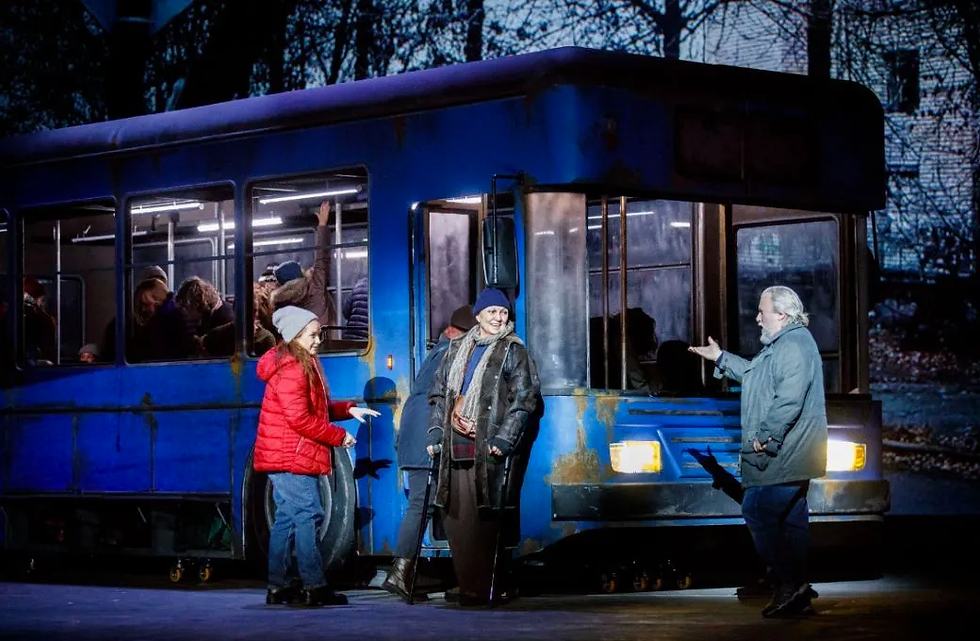
Directed by Barbara Wysocka, the production consumed its audience, demonstrating just how brutal and unjust reality can be. The directorial and set design duo of Barbara Wysocka and Barbara Hanicka created a stage world with a gloomy, dense, almost foggy atmosphere. When these two artists work together, we often see a similar approach as in ‘Tosca’ or’ Romeo and Juliet.’ The artistic design of their operas usually features raw concrete walls framing the stage with projections shown on them. This was also the case here, and it worked brilliantly. The bare walls give the space a disturbing, dystopian feel, especially when paired with photos of dishevelled spaces shown above them. In the first act, this suggested that the action took place in a basement below deteriorating landscapes. During the second act, most of the action took place on an old blue bus against a backdrop of a moving landscape, creating the illusion that the bus was moving through a war-torn Ukraine. Nevertheless, the most striking visual effect occurred at the end of the second act, when one of the mothers: Kateryna desperately tried to free her child by going ‘live’ on Telegram. At this moment, we saw the character’s face in close-up, and thanks to Izabela Matuła’s exceptional acting skills, we witnessed a face full of pain and despair. Izabela Matuła was absolutely stunning in her role. She has a beautiful, dramatic soprano voice with secure high notes and a gorgeous timbre. She matches international superstars, and it is a shame she is not more renowned worldwide.
Another remarkably heavy and difficult role was performed by Małgorzata Walewska. She played the role of Olha, an ailing grandmother. Her performance was outstanding, both vocally and physically. The character moved around with the help of a wheelchair or crutches. You could really feel the elderly woman’s struggle with her own body and with the task of rescuing her granddaughter. The story ended with Olha collapsing at the gates of the ‘Camp Friendship,’ where her granddaughter was held. Olha died without ever having the chance to see Inna again. This also meant that Inna would not be coming home. Olha’s death and its outcome were undoubtedly some of the most emotionally draining parts of the opera. In fact, you could hear people sobbing in the audience.
The three main characters were completed by Kamila Dutkowska, who portrayed the second mother, Dasha. Her character brought a different quality to the story. Unlike her co-stars, she has a lighter, more lyrical voice with a beautiful natural vibrato. However, although her vocals were striking, her story felt somewhat unfinished as she did not get to see her daughter. It ended on a semi-optimistic note, suggesting that she will find her child someday. Perhaps her story was intended to symbolise hope for the 20,000 Ukrainian children who have not yet returned home. Or maybe it was a sign of perseverance. However, it felt a bit mechanical when an aria of outrage, fury and defeat would have been more expected.
We also saw Dasha’s daughter Olena and Kateryna’s – Lilia, played accordingly by Weronika Wojtkowska and Hanna Sosnowska-Bill, mostly inside the ‘summer camps.’ Both singers were exceptional, but Hanna Sosnowska-Bill stood out the most. She portrayed the young girl perfectly, developing from a naïve child to an almost motherly figure to another camp child. The singer has a bright, fresh-toned soprano voice, which allowed her to create the character of a teenager caught up in the tide of war. Another remarkable performance was Ólafur Sigurdarson’s portrayal of the elderly bus driver. He stood beside the brave women and facilitated their travel, acting as their guardian angel. Ólafur Sigurdarson portrayed his character with impeccable vocals. His voice was crystal clear, with amazing diction and strength. It carried calm and shreds of hope around the audience. The moment when he sat beside Olha’s corpse and sang a tragic eulogy was simply beautiful.
The opera had a substantial cast, with many smaller episodic roles, some of which were sung by selected choir members. While it is not possible to comment on all of them, I would like to mention Katarzyna Wietrzny’s performance as Maria Lvova-Bielova. Despite her limited stage time, she delivered a memorable performance. Her voice had a melodic quality, with beautiful high notes. Her only aria was performed with her surrounded by the children’s choir, which gave the whole scene a rather utopian feel: the beauty of her voice contrasted with atrocities she committed.
This artwork proves that opera can still be a relevant art form, capable of telling grand contemporary stories, such as this one. It is incredibly important that such stories continue to be told, especially in a world where people tend to forget about catastrophic events in Ukraine. Even within the opera industry, there is a tendency to look away. Some theatres are starting to stage works by Russian composers again. Some are welcoming Russian artists with open arms. Thus, one can only hope that this opera will remain a beautiful piece of art while also ensuring that nobody forgets this part of contemporary European history.
Iga Olszewska


Szukałem informacji o 'obserwacji ptaków w Polsce', ale przeglądarka z jakiegoś powodu błyskawicznie załadowała casino moneymoon przez pomyłkowe kliknięcie. Po zamknięciu tej zoptymalizowanej strony trafiłem na Wasz piękny wpis o sikorkach. Zdjęcia i opisy natury są niesamowicie relaksujące. Obserwowanie dzikiej przyrody to najlepszy sposób na odpoczynek po ciężkim tygodniu pracy w biurze!