
A Diva Reborn: Netrebko Rediscovers Her Vocal Youth in an unforgettable night in Liceu
Aida, Giuseppe Verdi
Gran Teatre del Liceu, Barcelona
25th. September 2026
Aida, Giuseppe VerdiGran Teatre del Liceu, Barcelona25 September 2026
Voices: Anna Netrebko, Ekaterina Semenchuk, Ivan Gyngazov, Artur Ruciński, Alexander Köpeczi, George Andguladze, Moisés Marín, Carmen Buendía. Conductor: Antonello Manacorda. Director: Shirin Neshat. Stage design: Christian Schmidt.

As happened with Ai Weiwei’s much-criticised Turandot in Rome, when political protest enters the opera house in the hands of artists who have themselves been persecuted in their countries of origin, the opera in question tends, to some extent, to disappear. Yet, as was also the case with Ai Weiwei, in the terrifying world we inhabit — a world in which women are killed for refusing to wear the veil, in which they are mistreated, and in which war continues to spread — productions such as Shirin Neshat’s are necessary. They give a voice to the persecuted, to those whom political and ideological forces have sought to silence.
That said, do not go to this production expecting to find the Aida you know, because you will not find it. You will find something else. Anyone with Zeffirelli or Mestres Cabanes in their memory will probably leave the theatre saddened. And although, as I have said, I believe productions conceived by persecuted artists such as these are necessary, that does not mean we should consign the great stagings we already possess — such as the historic Mestres Cabanes production — to a drawer.
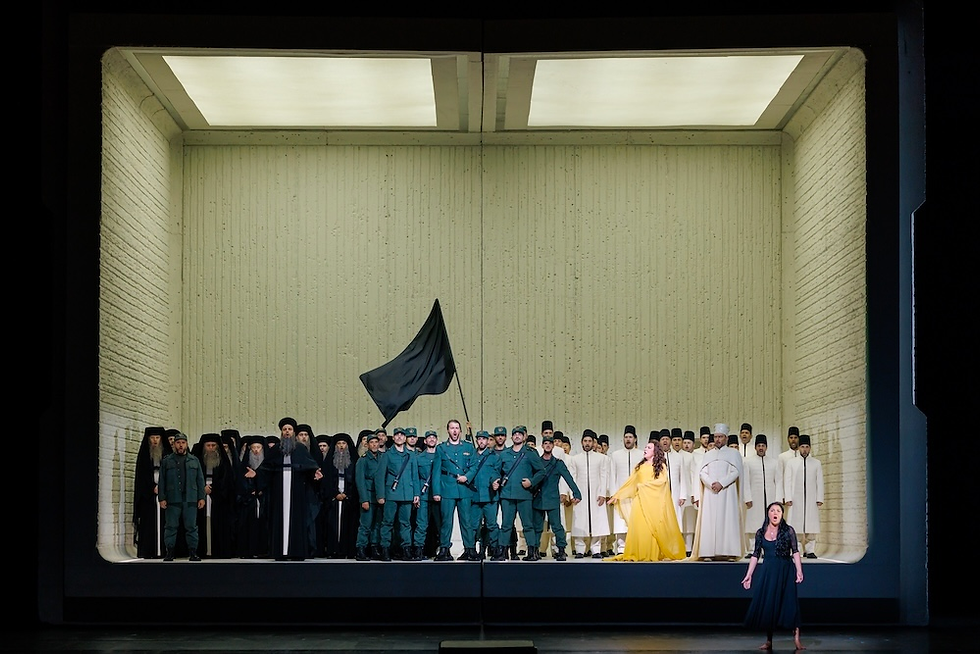
Neshat’s production is neither irritating nor gratuitously provocative, nor does it seek to destroy the work, although it does not build very much upon it either. Visually, it is colourful and dramatic, with particular praise due to the superb lighting and the filmed projections that accompany certain moments. The complete elimination of the ballets, however, is a serious mistake, leaving much of Act II curiously flat and dramatically purposeless. Neshat’s imagery and dramaturgy can possess considerable depth and impact, but Christian Schmidt’s set, essentially a vast box resembling an enormous block of polystyrene, is simply too basic and visually ineffective.
Anna Netrebko seems to have rediscovered her essence, the singer who once dazzled Vienna alongside Villazón, for her performance last night was sublime, a display of singing and technique at the highest level. Some will write that she did not maintain quite the same standard throughout the evening, or that she truly came into her own only in O patria mia. But I should like to see how many singers, confronted by what I regard as unjust demonstrations against them outside the theatre, would not only resist cancelling but then go on to sing an Aida such as the one Netrebko gave us last night.
There were no shrill excesses, no empty vocal acrobatics: instead, she built her portrayal through detail, refinement and those closed-mouth pianissimi that only the greatest singers can truly command. What Netrebko gave us was a demonstration of what it means to be a genuine diva: even in such unwelcoming circumstances, she could walk onto the stage and show, with astonishing apparent ease, that she remains capable of delivering an historic, virtually flawless Aida.
At moments, particularly towards the end of the aforementioned O patria mia, but also in Ritorna vincitor!, it seemed almost as though we were hearing Montserrat Caballé’s voice once again on the stage of the Liceu. But no: this was Anna Netrebko, still capable, against all odds, of singing even better than she did at twenty. Her lower register, now darker and more guttural, has acquired an extraordinary dramatic weight that few sopranos can match, without sacrificing the delicacy of her upper register — something quite remarkable at this stage of a soprano’s career. Long live the diva.
Beside her, Ekaterina Semenchuk was in glorious form, her voice imposing, dramatic and enormous, at times almost capable of overshadowing her friend Anna. Semenchuk is an extraordinarily versatile singer, seemingly able to tackle almost anything with formidable assurance and impeccable technical command. Her Amneris has tremendous power and presence. Do not miss her.
Ivan Gyngazov was an excellent Radamès, secure throughout and equipped with the metallic, warrior-like voice the role demands, although some listeners may prefer a more refined instrument. Yet Gyngazov combines sheer power with vocal excellence, and his Radamès held his own magnificently alongside Netrebko in an evening that will not easily be forgotten.
Alexander Köpeczi, meanwhile, is demonstrating that he needs no patrons or champions: his bass voice and formidable technical command speak entirely for themselves. His performance last night was, indeed, among the finest of the evening. The remaining members of the cast — Artur Ruciński, George Andguladze, Moisés Marín and Carmen Buendía — also deserve mention for their consistently committed and accomplished contributions.
We had come from Madrid’s Teatro Real, where the chorus on opening night had fallen short of expectations. So bravo to the Liceu Chorus, for rarely has it sounded as impressive as it did last night. Its interventions displayed impeccable blend, harmony and unity, at times seeming to sing as a single voice and making, on occasion, an even greater impact than the orchestra itself.
The orchestra, for its part, sounded considerably better than usual, although this never became a truly overwhelming Aida from the pit. Antonello Manacorda’s conducting ultimately lacked the force, tension and bravura needed to transform a vocally exceptional performance into an equally memorable Verdian evening.
Dr. Eloi de Tera
Director of Lohengrin Magazine

Aida, Giuseppe Verdi
Gran Teatre del Liceu, Barcelona
25th. September 2026
Voices: Anna Netrebko, Ekaterina Semenchuk, Ivan Gyngazov, Artur Rucinski, Alexander Köpeczi, George Andguladze Moisés Marín, Carmen Buendía. Conductor: Antonello Manacorda. Director: Shirin Neshat. Stage design: Christian Schmidt
Como ocurrió con la tan criticada Turandot de Ai Weiwei en Roma, cuando la denuncia política entra en escena de la mano de artistas perseguidos en sus países de origen, la ópera en cuestión acaba, en cierto modo, desapareciendo. Sin embargo, como sucedía también con Ai Weiwei, en este mundo de terror en el que vivimos —con países donde se mata a mujeres por no llevar velo, donde son maltratadas y donde la guerra se extiende por doquier—, propuestas como las de Shirin Neshat resultan necesarias: son la voz de quienes han sido perseguidos y de aquellos a quienes se ha pretendido silenciar por razones políticas e ideológicas.
Eso sí: no vayan a ver esta producción esperando encontrar la Aida tradicional, porque no la encontrarán. Hallarán otra cosa. Quien tenga en la memoria a Zeffirelli o a Mestres Cabanes probablemente saldrá entristecido. Y aunque, como digo, considero necesarias estas producciones concebidas por artistas perseguidos, ello no significa que debamos guardar en un cajón los grandes montajes que ya tenemos, como el histórico de Mestres Cabanes.
La producción de Neshat no resulta molesta, ni busca provocar gratuitamente ni destruir la obra, aunque tampoco construye demasiado a partir de ella. Visualmente es colorista y dramática, y merecen especial mención el magnífico trabajo de iluminación y las proyecciones cinematográficas que acompañan determinados momentos. Sin embargo, elimina por completo los ballets, y este es un grave error, pues el segundo acto termina convirtiéndose en algo desvaído y carente de sentido. Las imágenes y la dramaturgia de Neshat poseen profundidad y fuerza, pero la escenografía, consistente fundamentalmente en una enorme caja que recuerda a un gigantesco bloque de porexpán, resulta demasiado simple y poco efectiva.
Anna Netrebko parece haber regresado a su esencia, a aquella cantante que deslumbraba en Viena junto a Villazón, porque su interpretación de ayer fue sublime y una exhibición de la mejor técnica. Algunos escribirán que no mantuvo el mismo nivel durante toda la función y que únicamente destacó en O patria mia. Pero me gustaría ver qué cantante, encontrándose con manifestaciones injustas contra ella a las puertas del teatro, sería capaz de no cancelar y, además, ofrecer una Aida como la que Netrebko nos regaló ayer.
Sin estridencias ni malabarismos efectistas, construyó el personaje desde el detalle, la finura y unos pianissimi a boca cerrada que solo están al alcance de las grandes. Lo de Anna fue una demostración de lo que significa ser una auténtica diva: incluso en circunstancias tan poco amables, salir al escenario y demostrar, con una aparente facilidad asombrosa, que todavía puede ofrecer una Aida histórica y prácticamente sin mácula.
Por momentos, sobre todo al final de la citada O patria mia, pero también en Ritorna vincitor!, nos pareció volver a escuchar la voz de Montserrat Caballé sobre el escenario del Liceu. Pero no: era Anna Netrebko, todavía capaz, contra viento y marea, de cantar incluso mejor que cuando tenía veinte años. Sus graves, ahora más guturales, han adquirido un dramatismo extraordinario que pocas sopranos pueden alcanzar, sin que por ello haya perdido la delicadeza del registro agudo, algo verdaderamente excepcional en una soprano a estas alturas de su carrera. Larga vida a la diva.
A su lado, Ekaterina Semenchuk apareció pletórica, con una voz imponente, dramática y enorme, capaz por momentos casi de ensombrecer a su amiga Anna. Semenchuk es una cantante todoterreno, capaz de enfrentarse prácticamente a cualquier repertorio con una seguridad apabullante y un dominio técnico impecable. Su Amneris posee una fuerza y una presencia extraordinarias. No se la pierdan.
Ivan Gyngazov fue un Radamés excelente, seguro y de voz metálica y guerrera, como corresponde al personaje, aunque algunos quizá prefieran un instrumento de mayor delicadeza. Pero Gyngazov combina potencia y excelencia vocal, y su Radamés se impuso con autoridad junto a Netrebko en una noche difícil de olvidar.
Alexander Köpeczi, por su parte, está demostrando que no necesita padrinos: su voz de bajo y su enorme dominio técnico hablan por sí solos. Su interpretación de ayer estuvo, de hecho, entre lo mejor de la noche. Merecen destacarse asimismo las voces que completaron el reparto —Artur Ruciński, George Andguladze, Moisés Marín y Carmen Buendía—, todos ellos solventes y entregados.
Veníamos del Teatro Real, donde en la noche del estreno el coro no estuvo a la altura. Pues bravo por el del Liceu, porque pocas veces se le ha escuchado cantar como ayer. Sus intervenciones mostraron un empaste, una armonía y una unidad impecables, hasta el punto de sonar prácticamente como una sola voz y causar, por momentos, mayor impacto que la propia orquesta.
Esta última sonó considerablemente mejor de lo habitual, aunque la lectura de Aida no terminó de resultar musicalmente arrolladora. A Antonello Manacorda le faltaron fuerza, tensión y bravura para elevar una función vocalmente excepcional hasta convertirse también, desde el foso, en una gran noche verdiana.
Dr. Eloi de Tera
Director de Lohengrin Magazine




Comentarios